
"Other ingredients": the line below the panel and how to read it
The line below the Supplement Facts panel is a regulated list: where it sits, what goes in it, why the order matters and why it prints no amounts.

Under the Supplement Facts box, in the smallest type on the label, there is one more line. It begins "Other ingredients" or just "Ingredients," and it is easy to skip. It is a regulated list with its own rules: where it sits, what it is called, what goes in it and in what order. On Rocket Fuel it is two words long.
Where the line sits and what it is called
The position is fixed. The ingredient list on a dietary supplement "shall be located immediately below the nutrition label," or, if there is no room there, "immediately contiguous and to the right of the nutrition label" (21 CFR 101.4(g)).
The heading depends on what the panel above already says. The list "shall be preceded by the word 'Ingredients,'" unless some ingredients, meaning sources, are identified inside the panel, "in which case the ingredients listed outside the nutrition label shall be in a list preceded by the words 'Other ingredients'" (101.4(g)). "Other" means other than the ones the panel has already named.
A source can be identified inside the panel in parentheses, the way "Calcium (as calcium carbonate)" does, or the dietary ingredient's own name can be the source (21 CFR 101.36(d)). Either way it "shall not be required to be listed again in the ingredient statement." How the panel itself is built is covered in Supplement Facts vs. Nutrition Facts.
What goes on it
Everything else. "Ingredients in dietary supplements that are not dietary ingredients or that do not contain dietary ingredients," the rule says, "shall be included in the ingredient list," and it gives examples: "such as excipients, fillers, artificial colors, artificial sweeteners, flavors, or binders" (101.4(g)). FDA's labeling guide has a concrete case. Asked where a magnesium salt used as a binder must be declared, it answers: "You must list the specific magnesium salt in the ingredient statement below the 'Supplement Facts' panel" (question 10).
The rule names those categories without defining them, and we don't define them here either. What the list gives you is names.
The order is information
Ingredients "shall be listed by common or usual name in descending order of predominance by weight" (101.4(a)(1)). The first name on the line is the one present in the largest amount by weight among those listed, the second is next, and so on.
There is one carve-out. The ordering requirements "do not apply to ingredients present in amounts of 2 percent or less by weight" when those ingredients are grouped at the end after a statement such as "Contains __ percent or less of ______" (101.4(a)(2)). A label that uses such a phrase is telling you where the small amounts begin.
Names are specific; amounts are not required
The names themselves are regulated: "The name of an ingredient shall be a specific name and not a collective (generic) name" (101.4(b)), with a list of exceptions that follows in the rule.
Amounts are a different matter. In the panel, a dietary ingredient line carries an amount per serving (a proprietary blend carries one total for the whole blend, a format we compared in an earlier post). In the passages we read, nothing asks the ingredient list to state amounts. The only provision is for a maker who chooses to give a percentage: "it shall be shown in parentheses following the name of the ingredient and expressed in terms of percent by weight" (101.4(e)). So the list ranks its entries. It does not measure them.
What the line tells you, and what it doesn't
| Question | What the line answers | Where the rule is |
|---|---|---|
| What is in the product besides the dietary ingredients? | Every ingredient that is not a dietary ingredient, by specific name | 21 CFR 101.4(g) and 101.4(b) |
| Which of them is present in the largest amount? | The first one listed; ingredients at 2 percent or less may be grouped at the end | 101.4(a)(1) and (a)(2) |
| How many milligrams of each? | Not answered: the passages we read do not ask for amounts here | 101.4(e) covers only a percentage the maker chooses to print |
| How do those amounts compare with the panel? | Not answered: the list ranks only its own entries | 101.4(a)(1) |
| Is a major food allergen present? | Named in parentheses inside the list, or in a "contains" statement beside it | FDA's food allergies page |
No amounts does not mean small amounts. The list ranks its own entries by weight and stops there. It does not say how much of anything is present, and it does not compare its entries with the amounts in the panel above.
The allergen statement lives next door
FDA's food allergies page says the allergen labeling law is enforced in most packaged food products and that "This includes dietary supplements." The food source of a major food allergen "must be declared at least once on the food label in one of two ways": "In parentheses following the name of the ingredient," with examples such as "lecithin (soy)," or "Immediately after or next to the list of ingredients in a 'contains' statement."
Either way, the place to look is this line and the sentence right after it. Read them together.
Rocket Fuel's line: two words
Rocket Fuel's line reads: xylitol, starch. That is the whole of it. The dietary ingredient, Natural Oyster Extract Powder, 300 mg, is named in the panel, so under 101.4(a)(1) it "need not be repeated in the ingredient list," which is why the line is headed "Other ingredients." The product page puts all three in one sentence: "The entire label: natural oyster extract powder, xylitol and starch."
The two words say that both are in the tablet, and xylitol is printed first, the position the rule gives to the ingredient that predominates by weight.
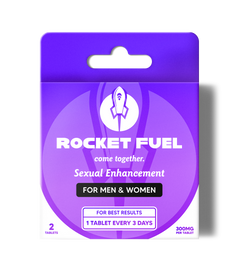
Beside the ingredients, the product page prints "Contains oyster (shellfish). Do not take if allergic."
A short line is still a declaration
Dietary supplements don't require FDA approval before sale; the label is the manufacturer's own declaration, and the line below the panel is part of it: a list of names, in order, that the maker puts its name to. Two words or twenty, it is read the same way.
Three things to read, in order. The heading: "Ingredients" or "Other ingredients." The first name: it leads by weight. The sentence after the list: that is where a "contains" statement sits.
If a name on the line raises a question about an allergy or about your own situation, that question is personal. Take it to a doctor or pharmacist, with the box in hand.
Questions people ask
Sources
- 21 CFR 101.4: Food; designation of ingredients · Legal Information Institute, Cornell Law School
- 21 CFR 101.36: Nutrition labeling of dietary supplements · Legal Information Institute, Cornell Law School
- Dietary Supplement Labeling Guide: Chapter IV. Nutrition Labeling · U.S. Food and Drug Administration
- Food Allergies · U.S. Food and Drug Administration
- Rocket Fuel product page · Shop Rocket Fuel
Figures quoted from other brands come from their public product pages and labels on the date shown above. If a label doesn't state a number, we say so rather than guess.
Informational only. This article is not medical advice and does not make claims about what any product does. Dietary supplements are not reviewed by the FDA before sale. These statements have not been evaluated by the Food and Drug Administration. This product is not intended to diagnose, treat, cure, or prevent any disease.

mg, mcg and IU: reading the units on a supplement label
What mg, mcg and IU mean on a Supplement Facts panel, which unit FDA's rule assigns to each line, and the one place IU still appears.
Supplement Facts vs. Nutrition Facts: why the two panels are not the same
Two headings, two sections of the same FDA rule: 21 CFR 101.36 for supplements and 101.9 for foods. What each panel must list, and why a...

What “Daily Value not established” means on a supplement label
The dagger and the footnote that appear on most supplement panels: which ingredients get them, what 21 CFR 101.36 requires, and what they do and don't...
Want to read our label?
Natural oyster extract powder, xylitol, starch. 300 mg of oyster extract per tablet, one tablet every 3 days. Free US shipping on every order.
For adults 18+. Rocket Fuel contains shellfish (oyster).