
Supplement Facts vs. Nutrition Facts: why the two panels are not the same
Two headings, two sections of the same FDA rule: 21 CFR 101.36 for supplements and 101.9 for foods. What each panel must list, and why a box shows one.

A box of crackers and a box of Rocket Fuel carry panels that look like cousins: a hairline box, a heavy heading, "Serving Size" near the top, a "% Daily Value" column down the right. They are not the same panel. The food panel is written by 21 CFR 101.9 and titled "Nutrition Facts"; the supplement panel by 21 CFR 101.36, titled "Supplement Facts." The differences run deeper than the heading.
Two headings, two sections of the same rule
The food rule opens wide: nutrition information "shall be provided for all products intended for human consumption and offered for sale unless an exemption is provided" (21 CFR 101.9(a)). Its format section adds the name: "The information shall be presented under the identifying heading of 'Nutrition Facts'" (101.9(d)(2)).
The supplement rule is a section of its own. A dietary supplement "shall bear nutrition labeling in accordance with this regulation" (101.36(a)), and the regulation names its panel: "The title, 'Supplement Facts,' shall be set in a type size larger than all other print size in the nutrition label" (101.36(e)(1)). FDA's labeling guide: "The nutrition label for a dietary supplement is called a 'Supplement Facts' panel" (question 1).
So the heading is not a style choice: it tells you which section the maker is labeling under. One box, one heading.
The differences in one table
| Line | Nutrition Facts (21 CFR 101.9) | Supplement Facts (21 CFR 101.36) |
|---|---|---|
| Heading | "Nutrition Facts" (101.9(d)(2)) | "Supplement Facts," in type larger than all other print in the panel (101.36(e)(1)) |
| Serving size | An amount "customarily consumed per eating occasion," in a household measure (101.9(b)(1)) | A count in the product's form: "tablets," "capsules," "packets," "teaspoonfuls" (101.36(b)(1)(i)) |
| Nutrients at zero | Expressed as zero: total fat under 0.5 gram "shall be expressed as zero" (101.9(c)(2)) | "Shall not be declared" when absent or at a zero-declarable amount (101.36(b)(2)(i)) |
| Ingredients with no Daily Value | Not part of the panel; 101.9(c) lists nutrients, vitamins and minerals | Listed by name and amount, with a symbol: "Daily Value not established" (101.36(b)(3)) |
| Vitamins and minerals required | Vitamin D, calcium, iron, potassium, "in that order" (101.9(c)(8)(ii)) | The same four, declared only when present above the zero threshold (101.36(b)(2)(i)) |
| Footnote | "The % Daily Value tells you how much a nutrient in a serving of food contributes to a daily diet" (101.9(d)(9)) | "Percent Daily Values are based on a 2,000 calorie diet" (101.36(b)(2)(iii)(D)) |
Serving size: a measure of food or a count of units
For food, a serving is "an amount of food customarily consumed per eating occasion by persons 4 years of age or older which is expressed in a common household measure that is appropriate to the food" (101.9(b)(1)).
For a supplement, the unit is the product itself. Serving size "shall be expressed using a term that is appropriate for the form of the supplement, such as 'tablets,' 'capsules,' 'packets,' or 'teaspoonfuls'" (101.36(b)(1)(i)). FDA's guide translates the table entry behind it: "One serving of a dietary supplement equals the maximum amount recommended, as appropriate, on the label for consumption per eating occasion" (question 4).
What each panel must list, and what it may leave out
The food panel is a fixed roster. Calories, the fat lines, cholesterol, sodium and the carbohydrate lines run down in order (101.9(c)), and the mineral rows "shall include vitamin D, calcium, iron, and potassium in that order" (101.9(c)(8)(ii)). Small amounts do not disappear: total fat under 0.5 gram per serving "shall be expressed as zero" (101.9(c)(2)), and an "insignificant amount" is "that amount that allows a declaration of zero in nutrition labeling" (101.9(f)(1)). A food panel keeps its zero lines.
The supplement panel starts from the same roster and subtracts. The regulation names fifteen "(b)(2)-dietary ingredients": "total calories, total fat, saturated fat, trans fat, cholesterol, sodium, total carbohydrate, dietary fiber, total sugars, added sugars, protein, vitamin D, calcium, iron, and potassium" (101.36(b)(2)(i)). They appear only "when they are present ... in quantitative amounts by weight that exceed the amount that can be declared as zero." Items that are absent, or at a zero-declarable amount, "shall not be declared." FDA's guide puts it bluntly: "You are not permitted to list 'zero' amounts of nutrients in the 'Supplement Facts' panel for dietary supplements" (question 2).
A food panel shows you zeros. A supplement panel may not, so a short supplement panel means the other lines did not clear the threshold.
The guide is older than the rule. FDA's Dietary Supplement Labeling Guide, Chapter IV, is dated April 2005 and marked "Contains Nonbinding Recommendations." Its question 6 still lists vitamin A, vitamin C and "calories from fat" as required; the current 101.36(b)(2)(i), amended through December 21, 2018, lists vitamin D and potassium instead and drops calories from fat. Where they disagree, read the regulation.
The symbol line: ingredients with no Daily Value
Here the panels part ways for good. The supplement rule adds a category the food panel has no line for: "other dietary ingredients," which "shall be declared by their common or usual name when they are present in a dietary supplement" (101.36(b)(3)(i)), with the amount per serving beside the name (101.36(b)(3)(ii)). With no Daily Value, the right-hand column cannot hold a percentage. Instead, "Other dietary ingredients shall bear a symbol (e.g., an asterisk)" pointing to a footnote that reads "Daily Value not established" (101.36(b)(3)(iv)). The "e.g." leaves the choice of mark open, so a dagger serves as well.
Two more lines exist only on this side: botanicals must "specify the part of the plant from which the ingredient is derived" (101.36(d)(1)), and a proprietary blend lists its total weight "on the same line" as its name, with the ingredients inside "in descending order of predominance by weight" (101.36(c)), a format we read line by line in an earlier post.
Rocket Fuel's panel, read under 101.36
Rocket Fuel is a dietary supplement, so its box carries a Supplement Facts panel and every line above applies to it. Serving Size is 1 tablet, a term for the form of the product, as 101.36(b)(1)(i) asks. There is one dietary ingredient line: Natural Oyster Extract Powder, 300 mg. Oyster extract powder has no Daily Value, so that line follows the (b)(3) format: common or usual name, amount per serving, and the symbol pointing to "Daily Value not established." The panel prints no extract ratio and no species, so those are not stated.
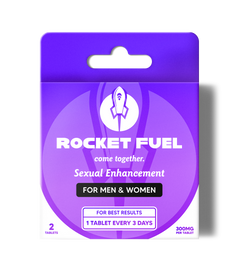
Below the panel comes the ingredient statement, where the guide puts everything that is not a dietary ingredient, "such as binders, excipients, fillers" (question 10). Rocket Fuel's reads xylitol and starch. The directions, 1 tablet every 3 days, and the warnings on the product page, "Contains oyster (shellfish). Do not take if allergic." and "Not intended for anyone under 18," are the manufacturer's own lines outside the panel; we quote them and stop.
A two-second check. "Supplement Facts" means 101.36 applies: expect a count of units in Serving Size and a symbol in the % Daily Value column. "Nutrition Facts" means 101.9 applies: expect a household measure, a fixed list of nutrients, and zeros printed as zeros.
One rule each, and a declaration either way
Both panels are declarations, not certificates. Dietary supplements don't require FDA approval before sale, and the Supplement Facts panel is the manufacturer's own declaration of what is in the box, in the format 21 CFR 101.36 prescribes; the Nutrition Facts panel is the food maker's declaration under 21 CFR 101.9. The two stay linked at the edges: "Dietary supplements shall be subject to the misbranding provisions of § 101.9(k)" (101.36(j)). If the question is personal, take it to a doctor or pharmacist, with the box in hand.
Questions people ask
Sources
- 21 CFR 101.36: Nutrition labeling of dietary supplements · Legal Information Institute, Cornell Law School
- 21 CFR 101.9: Nutrition labeling of food · Legal Information Institute, Cornell Law School
- Dietary Supplement Labeling Guide: Chapter IV. Nutrition Labeling · U.S. Food and Drug Administration
- Rocket Fuel product page · Shop Rocket Fuel
Figures quoted from other brands come from their public product pages and labels on the date shown above. If a label doesn't state a number, we say so rather than guess.
Informational only. This article is not medical advice and does not make claims about what any product does. Dietary supplements are not reviewed by the FDA before sale. These statements have not been evaluated by the Food and Drug Administration. This product is not intended to diagnose, treat, cure, or prevent any disease.
What “Daily Value not established” means on a supplement label
The dagger and the footnote that appear on most supplement panels: which ingredients get them, what 21 CFR 101.36 requires, and what they do and don't...

Why Rocket Fuel is a rounded triangle: inside the tablet and the box
A tour of the Rocket Fuel box as printed: the rounded-triangle tablet, the one-line panel, the every-3-days directions line and the two warnings.
Oyster extract powder: what the ingredient name on our label means
Natural Oyster Extract Powder, 300 mg: what each word on the Rocket Fuel ingredient line states under the naming rules, and what the panel leaves unstated.
Want to read our label?
Natural oyster extract powder, xylitol, starch. 300 mg of oyster extract per tablet, one tablet every 3 days. Free US shipping on every order.
For adults 18+. Rocket Fuel contains shellfish (oyster).