
Third-party tested vs. GMP vs. FDA-registered: what each means on a box
Three phrases on a supplement box that can sound like one credential: a regulation, a filing and a relationship. What each one points to, in plain words.

"FDA-registered." "GMP." "Third-party tested." The three phrases often share a single sentence on a supplement box or a product page. Read quickly, a sentence like that sounds like one credential. It holds three different kinds of statement: one points to a regulation, one to a filing, and one to a relationship between a brand and an outside lab. This post reads each against the page that stands behind it.
Three phrases, three kinds of statement
The quickest way to keep them apart is to ask who stands behind each phrase and what it rests on.
| Phrase | Who stands behind it | What it rests on | Where to read more |
|---|---|---|---|
| GMP | FDA, through a regulation | 21 CFR part 111, a set of duties for anyone who manufactures, packages, labels or holds a dietary supplement | The rule itself, 21 CFR part 111 |
| FDA-registered | The facility, by filing with FDA | Registration information submitted to FDA and renewed every other year | FDA's page on food facility registration |
| Third-party tested | A lab or certifier that is not the maker | Whatever test or program the brand chose, for example USP's or NSF's | The page of the program named, such as USP's or NSF's |
GMP: a regulation written as duties
GMP stands for good manufacturing practice, and for dietary supplements it has an address: 21 CFR part 111, titled in full Current Good Manufacturing Practice in Manufacturing, Packaging, Labeling, or Holding Operations for Dietary Supplements. Its first section says who it covers: "you are subject to this part if you manufacture, package, label, or hold a dietary supplement" (21 CFR 111.1(a)). The definitions spell out the "you": "a person who manufactures, packages, labels, or holds dietary supplements" (111.3).
The part runs to sixteen subparts, A to P, and the sections we read are written as instructions: "You must have qualified employees" (111.12(a)), "You must implement a system of production and process controls" (111.55). That makes GMP a legal baseline that applies to every maker.
FDA-registered: a facility on a list
FDA's page on food facility registration starts from a 2002 law and the regulations written under it, which require that "Food facilities register with FDA"; the page says those regulations have applied since December 12, 2003. A law enacted on January 4, 2011 added that "facilities engaged in manufacturing, processing, packing, or holding food for consumption in the United States" submit more registration information, "including an assurance that FDA will be permitted to inspect the facility." The same paragraph says registered facilities must "renew such registrations every other year" and that FDA may suspend a registration in certain circumstances. The page is tagged for two product categories, dietary supplements and food and beverages, and is marked current as of 01/12/2026.
Read what that describes. A facility files information and gives an assurance about inspection; FDA holds the registration and can suspend it. The word "approval" does not appear anywhere in the page's text. By the page's own description, "FDA-registered" is a statement about a facility's standing with FDA. It is not a statement about any product made inside.
Third-party tested: someone other than the maker
This phrase names a relationship, not a rule: a party other than the brand tested something. Programs that put a mark on a label publish what they check, and two of them show the range.
USP describes its program this way: "The USP Dietary Supplement Verification Program is a voluntary program open to manufacturers of dietary supplement finished products from around the world." In it, "USP evaluates voluntarily submitted products" against its standards "and FDA current good manufacturing practices."
NSF's page is more specific. "NSF certifies products against NSF/ANSI 173," which it calls "the only American National Standard that establishes requirements for the ingredients in dietary and nutritional supplements." It lists three parts: "Label claim review to certify that what's on the label is in the bottle," a toxicology review of intentionally added ingredients, and "Contaminant review to ensure the product contains no undeclared ingredients or unacceptable levels of contaminants." The checking repeats: "NSF conducts annual audits and periodically retests each dietary supplement."
Both pages are the programs' own descriptions of themselves, and we quote them as such. The point for a label reader is narrower: a named program can be looked up, and its page says what the mark covers.
Look for a name. "Third-party tested" with a program named next to it gives you something to look up: the program's own page says what its mark covers and how often the checking is repeated.
Rocket Fuel's sentence, as printed
Rocket Fuel's product page puts all three in one line: "produced in an FDA-registered, GMP-certified facility and independently third-party tested." We quote the line as printed.
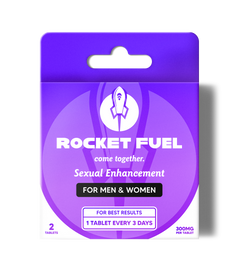
The label itself is short: one dietary ingredient, Natural Oyster Extract Powder, 300 mg per tablet, with xylitol and starch as the other ingredients.
The three phrases at a glance
The same reading applies to any box that carries them:
- GMP points to 21 CFR part 111, the manufacturing rule that applies to every supplement maker.
- FDA-registered describes a facility that has filed its registration with FDA and renews it every other year.
- Third-party tested means someone other than the maker ran the tests; a named program, such as USP's or NSF's, publishes what its mark covers.
Three statements by the maker, not three approvals
None of the three phrases is an FDA sign-off on a product. Dietary supplements don't require FDA approval before sale, and the label is the manufacturer's own declaration of what is in the box. The three phrases are declarations of the same kind: the maker telling you which rule it operates under, where its facility stands with FDA, and that someone outside the company looked. Part 111 applies to a supplement maker whether or not the box mentions it (111.1(a)). If your question is whether a product suits you, take it to a doctor or pharmacist, with the box in hand.
Questions people ask
Sources
- 21 CFR part 111: Current good manufacturing practice in manufacturing, packaging, labeling, or holding operations for dietary supplements · Legal Information Institute, Cornell Law School
- 21 CFR 111.1: Who is subject to this part? · Legal Information Institute, Cornell Law School
- Registration of Food Facilities and Other Submissions · U.S. Food and Drug Administration
- Dietary Supplements Verification Program · U.S. Pharmacopeia (USP)
- Supplement and Vitamin Certification · NSF
- Rocket Fuel product page · Shop Rocket Fuel
Figures quoted from other brands come from their public product pages and labels on the date shown above. If a label doesn't state a number, we say so rather than guess.
Informational only. This article is not medical advice and does not make claims about what any product does. Dietary supplements are not reviewed by the FDA before sale. These statements have not been evaluated by the Food and Drug Administration. This product is not intended to diagnose, treat, cure, or prevent any disease.
Tablet vs. capsule vs. gummy: what changes on the label, not just the shape
One labeling rule covers tablets, capsules and gummies. The form changes the serving-size unit, the panel's nutrient lines and the ingredient list.

Serving size vs. directions: the two lines that decide how long a box lasts
Serving size says how much one serving is; the directions say how often. Together they set servings per container, days per box and price per day.
Rocket Fuel vs. a proprietary-blend tablet: the two labels, line by line
Rocket Fuel's one-ingredient panel next to the proprietary-blend format as 21 CFR 101.36 defines it: what each line states and what you can calculate from it.
Want to read our label?
Natural oyster extract powder, xylitol, starch. 300 mg of oyster extract per tablet, one tablet every 3 days. Free US shipping on every order.
For adults 18+. Rocket Fuel contains shellfish (oyster).