
Tablet vs. capsule vs. gummy: what changes on the label, not just the shape
One labeling rule covers tablets, capsules and gummies. The form changes the serving-size unit, the panel's nutrient lines and the ingredient list.

A tablet, a capsule and a gummy can carry the same ingredient in the same amount and still wear three different-looking labels. The rule behind all three is the same one: 21 CFR 101.36 for the Supplement Facts panel and 21 CFR 101.4 for the ingredient list. What changes with the form is how the blanks get filled in.
One rule for every form
The supplement labeling rule has no separate chapter for tablets, capsules or gummies. It names forms only as examples: serving size "shall be expressed using a term that is appropriate for the form of the supplement, such as 'tablets,' 'capsules,' 'packets,' or 'teaspoonfuls'" (21 CFR 101.36(b)(1)(i)). The word "gummy" does not appear in the passages we read. The phrase "such as" leaves room for it.
So the comparison is not three rule books. It is one set of fields, filled in three ways.
The serving-size line names the form
The first field that changes is the unit. A tablet label counts tablets, a capsule label counts capsules, and the heading over the amounts may follow suit: a heading "such as 'Each Tablet Contains,' or 'Amount Per 2 Tablets' may be used in place of the heading 'Amount Per Serving'" (101.36(b)(2)(i)(A)).
The number in front of the unit matters more than the unit. Amounts on the panel are per serving, and a serving can be 1 tablet or 2 capsules. FDA's labeling guide allows a second basis beside it: "You may declare information on a 'per unit' basis in addition to the required 'per serving' basis" (question 19). If a label shows only per serving, divide by the units in a serving yourself.
The panel can grow lines
The panel's nutrient lines depend on what is in a serving, whatever the form. The regulation lists fifteen items, from total calories through total sugars and added sugars to potassium, that are declared when present "in quantitative amounts by weight that exceed the amount that can be declared as zero" (101.36(b)(2)(i)). Below that threshold they "shall not be declared," a point we covered in Supplement Facts vs. Nutrition Facts.
The rule does not ask what form the product takes. It asks what a serving contains. A form whose serving carries calories or sugars above the threshold shows those lines; a form whose serving does not, leaves them off.
The ingredient list is where the form shows
Below the panel sits the ingredient list, and this is where the form itself gets written down. Everything that is not a dietary ingredient goes there: "Ingredients in dietary supplements that are not dietary ingredients, such as binders, excipients, fillers, must be included in the ingredient statement" (guide, question 10). The regulation's own list of examples is longer: "such as excipients, fillers, artificial colors, artificial sweeteners, flavors, or binders" (21 CFR 101.4(g)).
Whatever it takes to make a tablet a tablet, a capsule a capsule or a gummy a gummy is not a dietary ingredient, so it lands in this list, "in descending order of predominance by weight" (101.4(a)(1)). The passages we read do not say what any form is typically made of, and neither do we. Each label says it for its own product.
Three invented labels, one ingredient
To show where the differences sit, here are three labels invented for this post. Each carries 250 mg of an invented Ingredient A per serving. The names in the last rows are placeholders, not a statement of what any real tablet, capsule or gummy contains.
| Line on the label | Invented tablet | Invented capsule | Invented gummy |
|---|---|---|---|
| Serving Size | 1 tablet | 2 capsules | 2 gummies |
| Amount per serving | Ingredient A, 250 mg | Ingredient A, 250 mg | Ingredient A, 250 mg |
| Amount per unit (our arithmetic) | 250 mg | 125 mg | 125 mg |
| Units in the container | 30 | 60 | 60 |
| Servings per container | 30 | 30 | 30 |
| Other ingredients | Binder B, Sweetener C | Shell material D, Filler E | Sweetener C, Sweetener F, Gelling ingredient G, Flavor H, Color J |
| Entries in that line | 2 | 2 | 5 |
All three state the same 250 mg per serving for 30 servings. The capsule and gummy boxes say 60 on the front; the tablet box says 30. The gummy's ingredient line is the longest because we wrote it that way, to show what a long line looks like. On a real shelf, read the line; do not assume it from the form.
Four things to compare across forms. The amount per serving, not per unit. The servings per container, not the units. The other-ingredients line, name by name. And the allergen statement beside it.
Allergen statements follow the ingredients, not the form
FDA's page on food allergies says the allergen labeling law is enforced in most packaged food products, and adds: "This includes dietary supplements but does not include meat, poultry, and egg products." The requirement is tied to what a product is made with: "The law requires that food labels identify the food source of all major food allergens used to make the food."
The declaration appears in one of two places: "In parentheses following the name of the ingredient," or "Immediately after or next to the list of ingredients in a 'contains' statement." The ingredients that give a product its form are ingredients like any other, so two forms of the same dietary ingredient can carry different allergen statements.
Rocket Fuel: a tablet, and what its label fills in
Rocket Fuel is sold as a tablet, shaped as a rounded triangle (the shape has its own post). Its fields read: Serving Size 1 tablet; one dietary ingredient line, Natural Oyster Extract Powder, 300 mg; and an ingredient statement of two entries, xylitol and starch. Beside them, the product page prints a "contains" line of its own: "Contains oyster (shellfish). Do not take if allergic."
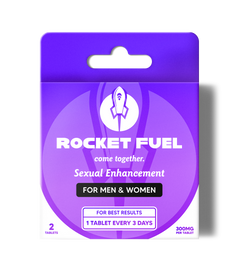
With a serving of 1 tablet, per serving and per unit are the same number, and a 2-tablet pack is 2 servings. At the time of writing Rocket Fuel is sold in this one form, so there is no capsule or gummy label of ours to set beside it.
Same rule, different fill-ins
Dietary supplements don't require FDA approval before sale; the label is the manufacturer's own declaration, whatever form the product takes. A tablet, a capsule and a gummy answer the same questions on the same panel. The form changes the unit, can change the number of nutrient lines, and shows up in the list below the panel.
The count on the front is units. Sixty capsules at 2 per serving is 30 servings. Compare servings first, then amounts per serving.
Which form is easier for you to take is a personal matter, and so is any question about an ingredient in the list. Those go to a doctor or pharmacist, with the box in hand.
Questions people ask
Sources
- 21 CFR 101.36: Nutrition labeling of dietary supplements · Legal Information Institute, Cornell Law School
- 21 CFR 101.4: Food; designation of ingredients · Legal Information Institute, Cornell Law School
- Dietary Supplement Labeling Guide: Chapter IV. Nutrition Labeling · U.S. Food and Drug Administration
- Food Allergies · U.S. Food and Drug Administration
- Rocket Fuel product page · Shop Rocket Fuel
Figures quoted from other brands come from their public product pages and labels on the date shown above. If a label doesn't state a number, we say so rather than guess.
Informational only. This article is not medical advice and does not make claims about what any product does. Dietary supplements are not reviewed by the FDA before sale. These statements have not been evaluated by the Food and Drug Administration. This product is not intended to diagnose, treat, cure, or prevent any disease.

Serving size vs. directions: the two lines that decide how long a box lasts
Serving size says how much one serving is; the directions say how often. Together they set servings per container, days per box and price per day.
Rocket Fuel vs. a proprietary-blend tablet: the two labels, line by line
Rocket Fuel's one-ingredient panel next to the proprietary-blend format as 21 CFR 101.36 defines it: what each line states and what you can calculate from it.
Single ingredient vs. proprietary blend: two supplement labels, read side by side
What a single-ingredient label states that a proprietary blend label doesn't, line by line, using the FDA labeling regulation as the referee.
Want to read our label?
Natural oyster extract powder, xylitol, starch. 300 mg of oyster extract per tablet, one tablet every 3 days. Free US shipping on every order.
For adults 18+. Rocket Fuel contains shellfish (oyster).